Dear XXX,
As you know, we failed in our attempt last year to criss-cross America and chronicle Homelessness and Poverty in a personal way. Carly fell in love with a newborn baby and never made it past Tacoma, Miki got septicemia in California, spent eight days in the hospital and struggled weakly through the rest of the summer, and the e-publisher who had promised us page space cut us off without any word or explanation.
We have not given up on what we think is an important story to tell. And, our vision has grown. We not only want to put a compassionate face on the poverty issue in America, we want to do "An American Family" scrapbook, dedicated to telling the story of one homeless person in every town and city we get to, and making them as well-known to you, and as well-loved, as any other relative you already know.
We've hit a brick wall. Many people have promised financial support to help make our vision a reality. None has actually followed through. For some it has been a matter of personal necessity, for others we aren't certain.
Miki was supposed to leave on this newly planned trip June 1st. She's still here at home working in the garden, working at a friend's farm, and praying desperately for an angel to help her.
We located a small camper for her to drive across America. We have the camper (if we can pay for it), and all of the materials she needs to do the photo-journalism part of things. We have a programmer to build us a new website, and a tentative offer to submit our articles to America Magazine for publication. At some point, we'd like to make this project into a documentary, and we have a couple of filmmakers who have expressed interest in helping us with this.
We need ten thousand dollars, last week.
It sounds like alot until you remember that everywhere Miki goes, she will be working voluntarily in shelters and soup kitchens across America, whilst chronicling the experience.
We also plan on using this trip as a way of getting a final commitment from other Catholic Workers to come and build a sister house to Gilbert House in Menomonie, Wisconsin as soon as possible. We have a friend of our house who has prayerfully put up the necessary seed money to fund that house's start up costs, all we need are the bodies to get it running.
Please help us.
Tuesday, June 7, 2011
Current Request

Monday, December 13, 2010
Ten Good Reasons Why Christmas Sucks Rocks
Christmas was always a kind a brutal tug of war in the family I grew up with. I had the very proper Eastern-bred paternal grandparents who threw lavish semi-formal parties in their home, complete with crystal chandeliers, a "don't even think about touching that" tree towering in every room, and fine linens protecting the mahogany table in the overly formal dining room, every horizontal surface crowded to excess with enough holiday food to feed a small town, and enough blended Scotch to keep all of the brothers and my grandfather very giggly and generous until everyone was exhausted and ready for sleep. Attendance was evidently mandatory and never really questioned - a situation that never sat well with my smoldering-tempered mother, who felt forcibly alienated from her own kin, and she made a point of saying so every chance she got.
On the other side of the familial fence there was my diminutive maternal "Gram." Hailing from a family of a dozen-or-so Nebraska-farm-reared siblings, five times married, and a veteran of the war-time entertainment stage, my Gram would pull out all the stops with parties where not a drop of alcohol was allowed, but guitars, banjos, singing, and games ran clean through the night and into dawn without respite, and not one person felt any need to argue about anything at all...which, if you've ever been within twenty miles of that family line, you know what a certifiable miracle is witnessed in such a feat.
Only once did my parents take my brothers and me to the latter family gathering. I was eight years old. Earlier that day, the Catholic church across the street from my Gram's house burned to the ground and, at some point, my Gram, my Great Grandma Grace, my mother, and I stood in the shadow of the carport under a clear black sky and just wondered at the acrid scent of dampened smoke in the air, and the sad, jumbled pile of dark grey granite stones across the way that had just one sunset before been the small fortress church where my mother had grown up and eventually found her conversion.
I stood under my Grandma Grace's shoulder just then and hugged her tight, breathed in the warm scent of lavender that permeated her tiny, soft, pearl-buttoned cardigan, and she held me close in return whilst she chatted quietly with her daughter and grand daughter. It was the first and the last time that I would ever get to spend Christmas with my great grandmother at her house; the following year she was in a nursing home and not long after her arrival, she fell, broke a hip, lost her left leg to sepsis, and faded quickly and quietly away in the Spring.
That last Christmas night, my Gram gave me one of her decorations; a tiny pearly-white plastic music box, shaped like a pipe organ, made festive with tiny sprigs of green plastic holly and a golden-winged angel sitting at the bench, tiny alabaster hands poised over imaginary keys that played, when the secret key in the back of the box was turned just so, a very tiny "Silent Night." The music stopped ages ago, but to this day, it is one of my favourite possessions. It reminds me of the night when my mother was home with her elder sisters and seemed almost happy--the only Christmas that I can actually remember when she did not loose her temper at some point, drag me into an empty room and paddle me silly for some indiscretion of manners, real or imagined. It is the only Christmas that I ever saw my Gram in her authentic, radiant element, playing the boisterous hostess to everyone she loved, whether related by blood or not. It was beautiful because it was simple, it was memorable because it was a night truly governed by peace in the midst of tragedy.
I was eighteen-years-old the last time I ever attended a family Christmas party. I stopped going because that year I tried to institute a new family tradition, and failed miserably. I came that night armed with a Bible, gathered everyone together in my grandparents' living room, and read the Nativity account from the Gospel of Luke. Three days later on Sunday morning just before I left for church with friends, my mother told me over the phone how embarrassed she was by such a "brazen display of hypocrisy" and she assured me with an unmistakable sneer that I had made a fool of myself by doing something so "stupid." The next year I just stayed in bed under the covers and read a book with a trusty box of chocolates at my side. The year after that I had the flu. Another year; I lived fifteen-hundred miles away and began a chosen pattern of working holidays so that others could go home to their own families.
...A decade more, and my paternal grandfather died; our family scattered silently to the Four Winds never to gather together in the same space again, just as my mother's family had done when Grandma Grace had left us. Over time misunderstandings and bitter tales of slights and crimes against egos would fracture, splinter, and eventually kill my family on both sides. In my immediate relations, after my parents divorced, sides were chosen, stories were told and scandalously embellished in the retelling, lines were drawn in concrete and, finally, there came that one empty, aching moment whilst watching the snow twinkle as it fell softly under the street lamp outside my window when I realised that the family that I missed and loved no longer existed, nor did anyone but me care to resurrect it. Not too many years ago I decided that it was time to call a spade a spade: for all practical purposes I am an orphan in this cold, massive world that my true mentor once called "the long loneliness," and there is no "home" to be at for Christmas in this or any other year.
I spend a lot of time with homeless people during the holidays, not out of any sense of devotion, but out of necessity. The holidays have a way of breeding guilt in the hearts of country club Christians who suddenly grow consciences that inform them (however wrongly) that condescending to some poor social lepers in the soup line for a few hours will expiate a mountain of sins against Charity. The poorest of the poor may be lacking in material blessings, but they aren't lacking in brains, or insight into human nature; they see the fraud afoot, and they graciously ignore it as best they can. What's the alternative?
I talk to many of these people during this season when city works departments start wrapping lamp posts in gaudy tinsel and glaring lights; they have often told me how grating the kettle bells are when they know that some nice bank vault will receive a fat, heavy bucket of guilt change that night whilst their own empty stomachs continue to gnaw and gurgle within them because they haven't got two dollars to spend on a cup of instant soup at the A & P.
Right now, at this precise moment, the Union Gospel Mission is turning men away because they haven't any room left to keep them. It's three degrees outside. I beg local donors for old blankets to stuff in our beaten wreck of a car so that we can go search for our friends who sleep down by the lake and the rivers where the police won't go looking for them. Every now and again, we luck out and someone dumps a black lawn bag of old mittens and hats and an occasional hunter's jacket on our covered porch without a word; it's not difficult to find barren bodies to put them on.
I have watched homeless men die of hypothermia whilst police officers mistakenly argue over whether they are just drunk or stoned. I have sat in our car and cried over weary mothers huddled in their own cars with children who do not understand that the reason that they cannot go home is because Daddy lost the rent money at the track or, worse, tried to strangle Mommy to death in a rage last week whilst they slept in the next room. I have had to run for cover in the face of one of the most obscene injustices I know: an honourably discharged disabled veteran returned from battle overseas, lying on crushed cardboard under the canopy of a tree in the Chancery park because our Congressional leaders chose to cut his pay and his benefits instead of their own whilst he was half a world away sacrificing life and limb for a war that should have never been waged in the first place....I am ashamed of what they have come home to, and I am ashamed to let them see me cry for their forgotten honour.
Often I ask these people if they have family; I am no longer disappointed when they tell me, "No." I used to be deeply bothered when a homeless person told me that they do not know whether their own parents, siblings, or children are alive or dead. I no longer wonder at the absurdity of someone telling me that they don't remember the last address their mother lived at, or that the last phone number they had for a brother or sister was disconnected ages ago.
In too many ways the homeless people whom I have come to regard as my family are veritable orphans. People in better circumstances are all too quick to assume that the bum on the street drinks or drugs themselves into a stupor out of selfishness or sloth. I know better. I know from first hand experience the dull, throbbing ache of the long loneliness; I know what it is to be so far away from kin that you know that you are a cipher in the deep, deep snow to those whom you love in absentia. I know what it is to weep over the loss of someone who you have only known in the exchange of a blanket and a kind word, or an hour in a warm, idling car over a shared cup of coffee and a cold sandwich.
Tonight one of our friends was found dead in a park. Flashes of smoldering piles of deep dark grey granite filled my mind as one of my police contacts told me that they "don't think he suffered much." I know that this statement is absolutely untrue, and I hate it that we live in a society that believes such lies. My friend at the police department asked me if our friend has any family that can be contacted. There is no one.
No one.
Another beautiful-but-nameless orphan in the world who was known to us and who will be known no more because he froze to death alone and unwanted in a public park. He's the tenth friend we have lost thus far this Winter, and Christmas hasn't even been and gone, yet.
I've decided that I absolutely hate Christmas, and this year I have ten very good reasons why:
Jonathan.
Katie.
Eddie.
Mark.
Uncle Jack.
Edith.
Badger.
Charles.
Tony.
Friday, October 22, 2010
Annual Appeal
Usually, the 15th of October is when we send out our annual appeal letter. Suffice it to say that none of us has had the time or energy to focus on such a task.
But our needs are huge.
We need another vehicle, and we are looking for gas money to get the furnace going, and also to get one of our kids back and forth from counseling.
We have also been feeding more drop-ins than usual, so any groceries are appreciated, as is coffee, toothbrushes, and bathroom tissue.
And if anyone knows how to fix bicycles, please let us know.
The garden is finally put to bed, and Mary Alice dropped off the last fifty pounds of squash down at the food pantry. It's going to be a hard, early winter, and most of our pumpkins are still green--not good. But we're dehydrating apples and carrots and all of the herbs have been brought in and put up.
Pray for us. And give us a call if you need anything, as well!
Monday, August 9, 2010
Protest Planned for Los Alamos, NM--Join them if you're in the area!
Monday, August 02, 2010
Protest Planned for Los Alamos
By Phil Parker
Journal Staff Writer
an atomic on the Japanese city of Hiroshima, an attack
meant to end World War II. Activists have mobilized on eight
acres in Chimayó with a plan to ensure that, on that day, Los
Alamos National Laboratory hears their calls for a nuke-free
world.
The 10-day event here — called Disarmament Summer Encampment — is
being organized by Think Outside the , a national nuclear
abolition group. Activists are camping on the grounds, owned by
Teresa Juarez, whose grandson Miguel Moreno lives there and is one
of Disarmament Summer's lead organizers. Seven of the family's
dogs run around freely during the daytime, and tents are
everywhere as nuclear opponents continued to fill up the camp on
Sunday.
The plan is to gather Friday at Ashley Pond in Los Alamos for a
rally that will incorporate performance art to tell stories of
nuclear power's damaging effects on communities around the
country. Then the group will march through the town and onto lab
property.
What the protest will look like has yet to be determined (there is
talk of puppets), but members of Think Outside the want the
whole procession carefully planned, so that when they take to the
atomic 's birthplace on Friday, they're armed with a group of
protestors educated on what exactly they're standing up for.
To that end, about 30 people gathered in a wide circle under a
tarp Sunday afternoon for a workshop called "Nukes 101." Speakers
from varying parts of the country took turns tackling a different
aspect of what they see as nuclear power's destructive legacy.
Twa-le Abrahamson told the group about the Spokane Reservation in
Washington, where she's from. Abrahamson said uranium mining went
on there for decades, beginning in the 1950s, and the health
effects have been devastating for tribal members who spent years
working the mines with no clue of the toll to their bodies.
"A lot of people are sick," she said. "There are a lot of widows."
Rozlyn Humphrey, from Aiken, S.C., said plutonium from the
Savannah River Site, built near Aiken in the 1950s to help
construct nuclear weapons, has done irreparable harm to the land
and river there.
"You dare not eat fish out of the Savannah River," she said. And
in a part of the country where hunting is dogma, she said, no one
hunts because radiation in the ground has caused the vegetation to
be contaminated, so animals that eat it aren't safe.
Other activists told similar tales, but the essential point of
Disarmament Summer Encampment may have been most plainly expressed
by Jennifer Nordstrom, from Racine, Wis.: "Nuclear weapons are
still being used — in testing and in the global politics of threat
and fear. ... New Mexico is the sacrificial state for the nuclear
weapons industrial complex."
Organizers with Think Outside the don't want the lab closed
down — Miguel Moreno said too many people in rural San Miguel
County depend on Los Alamos for work: "We don't want to take
anything away; we want that money, we just want it for something
good."
Think Outside the 's Jono Kinkade said his organization is
keeping a close eye on planning for a new plutonium pit in Los
Alamos. The lab earlier this year announced plans for its
Chemistry and Metallurgy Research Replacement building, which
would take a decade to build, with 22,500 square feet of lab
space, much for analyzing plutonium and other radioactive
materials. Funding for the building still hasn't been approved by
Congress, but the total price could be $4 billion, based on
National Nuclear Security Administration proposals.
"Stopping the CMRR (from being built) is a central focus," Kinkade
said. "We're trying to create political pressure, because that
money can be better spent on cleaner technology and renewable
energy."
LANL officials have said that the mission, for decades, has not
been to make new nuclear weapons but to maintain the country's
existing stockpile. As nuclear age, scientists need to
upgrade their technology. That work would be carried on at the
CMRR building. And former NNSA manager Don Winchell told an
audience in Española in June that the CMRR was vital for national
security because of nuclear forensics work that helps the
government track nuclear materials in other parts of the world.
"We're not building fancy new weapons," Winchell, who retired last
month, said then.
"If they want to have a beautiful, expensive new facility, why not
use it to create renewable energy?" Jennifer Nordstrom said.
"There could be an economic transformation if they changed their
focus from and destruction to life-changing renewables."
Think Outside the is hoping that message comes across loud
and clear Friday.
For more information on Think Outside the , visit
www.thinkoutsidethebomb.org.
Friday, June 11, 2010
Press Release
An Audacious Mission Trip
Miki Tracy and Carly Ann Koon, representatives of the Gilbert House Catholic Worker Community in Glenwood City, Wisconsin, have embarked on a four-month mission trip across the United States to document homelessness and poverty in America.
The germ for making this road trip was borne out of an unfortunate conversation this past year between Carly and a teacher at Glenwood City High School in which the teacher denied that there are well over half a million homeless on the streets at any given time in the United States. The same teacher also denied the accuracy of Federal statistics which have identified an overwhelming prevalence of pervasive mental illness within the homeless demographic, as well as a significant number of women, children and families. The posit that the homeless in our midst are out on the streets "of their own fee choice" was so disconcerting to Carly that she decided she had to find out for herself what is really happening out on the streets.
Carly and Miki are documenting what they can of the problem for themselves, visiting various organizations to see how volunteers across our great nation answer the needs of homelessness and poverty in their local communities "at a personal cost." Carly and Miki will be publishing an extensive photo-journalism project at the conclusion of their trip, as well as posting updates on our homepage, http://gilberthouse.blogspot.
Currently, Miki is serving at the Corpus Christi House of Hospitality in Boise, Idaho. Carly has gone on to Tacoma to meet up with friends of our community, and to interview and work with members of the Tacoma Catholic Worker. Carly and Miki will meet up late next week in Seattle to continue their journey to soup kitchens, shelters, Christ houses, and other related communities in the King and Pierce County area; they will then continue down the Pacific Coast through Oregon and California before working their way back East, stopping at communities in Utah, Wyoming, Colorado, South Dakota, and Minnesota. They will begin the eastern leg of this venture in Washington D.C. the first week of August, where they will be volunteering at other communities throughout the north-eastern U.S. before returning to Glenwood City sometime in Setember.
Mary Alice Calhoun and Amanda Hopkins have remained at Gilbert House to tend our garden so that our produce donations to the WestCap food pantry continue without decline or interruption.
Miki is a writer and Catholic apologist, and works with the American Catholic Writers Guild, as well as various national and international periodicals; she currently has several articles and essays in production, including the June issue of GILBERT Magazine. Carly is a recent graduate of Glenwood City High School and is currently discerning what (and where) she would like to study in her future college course.
For further information please visit our homepage. Miki and Carly may be reached at 715-308-8295 during the trip.
________________________
In His Grace,
Miki, Mary Alice, Amanda, Carly, and Friends
Gilbert House Catholic Worker
433 East Oak Street
Glenwood City, WI 54013
Monday, April 19, 2010
Daniel Berrigan has passed away. May GOD grant unto him eternal rest+++

Priest, keeper of the Word, risk-embracer
By Colman McCarthyFor NCR
I wrote Daniel Berrigan’s obituary the other day. The Jesuit priest, writer, teacher, dramatist, peacemaker, war resister and truth-teller who lives in New York City isn’t dead, of course, nor is he even close to being ill as he nears his 89th birthday this spring. The obituary editor at The Washington Post, my old paper, said he wanted an expansive piece written unhurriedly beforehand rather than risk a quickie dashed off under deadline pressure. In the newspaper world, advance obituaries are usually reserved for the giants -- presidents and popes. Which explains why Berrigan gets one: He is a giant.
I had time to go back and reread much of the stunningly large amount of ambiguity-free prose that is the Berrigan opus, from the early books such as Night Flight to Hanoi, No Bars to Manhood and False Gods, Real Men, to the later ones: Minor Prophets, Major Themes and To Dwell in Peace, his autobiography. And more poems, essays, journals and plays, early and late.
The richness of it all would stand alone as enduring literature. Yet the beauty of the language -- flexuous metaphors, spare allusions -- goes beyond the pleasures of reading well-crafted prose. Underlying it is the Berrigan conscience that consistently takes brave stands and embraces risks.
The larger forms of this priest’s defiance are well-known to anyone who has stayed even mildly abreast of the American peace movement in the past half-century. Tucked into the folds are the smaller but no less telling run-ins with power, starting with the presidents of Jesuit colleges and universities that sponsor ROTC programs. After teaching for a semester in 1989 at Loyola University in New Orleans, and taking his students on a field trip to learn how to get arrested at an antiwar rally, Berrigan wrote to the president that he wouldn’t be back due to his opposition to Loyola’s ROTC program. As recounted by Robert Ludwig in Apostle of Peace, the university president disagreed, replying that “given the reality of the military, it is better to have officers who have the benefit of a Jesuit education.”
Berrigan wrote back: “I love your logic. It seems to me that, given the reality of abortion, Loyola should sponsor an institute for abortionists, and given the reality of capital punishment, you should sponsor an institute for executioners.”
Equally searing was the Berrigan indictment of Jesuits as “masters of invention. They come out of the culture, they know how to take its pulse, try its winds and trim their sails. We’re not running the Little Brothers of Jesus. We’re not running the Catholic Worker. We’re running Georgetown University, [its] School of Foreign Service. We’re a nursery for the State Department.”
He could have added the Pentagon, now that President Obama’s chief national security advisor is retired Marine Gen. James L. Jones, a Georgetown graduate. As is Gen. George Casey Jr., chief of staff of the U.S. Army and a Georgetown ROTC graduate in May 1970. That same month Berrigan was underground, merrily on the lam evading an FBI manhunt after he refused to be imprisoned for his conviction of burning draft files in Catonsville, Md.
Presuming he read a recent issue of NCR, what must Daniel Berrigan have thought about a Georgetown Jesuit’s column hailing the current Obama war policies as “very Catholic”? Probably with the same sadness and subdued anger brought on by reading in the same issue an article titled “Bishops back Obama Afghanistan strategy” (NCR, Jan. 8).
I first met Berrigan in 1966. He came to Washington at the invitation of Sargent Shriver, who was then heading the Office of Economic Opportunity. The summer before, Berrigan had served as a tutor in an Office of Economic Opportunity migrant worker program in Colorado. In effect, he was a federal worker. He spoke at a Shriver staff meeting, saying that the poor have it hard, and the hardest thing they have is us. He predicted, rightly, that the Vietnam War would drain money from the war on poverty, and that both wars would be lost.
I last saw Dan a few years ago when he officiated at the wedding of Arthur Laffin and Colleen McCarthy, two pacifists who help run the Dorothy Day Catholic Worker house in Washington. It was a festive event, with Dan at his priestly best and the wedding guests feeling blessed to enjoy the company of a rare keeper of the Word.
[Colman McCarthy teaches peace studies in several Washington schools.]
An Audacious Mission Trip--Flying by the Seat of our Pants, and then some....
The week after they both graduate from high school on May 23rd, we plan on taking Carly and Amanda (Lilly) on a mission roadtrip. The goal of this roadtrip is to introduce them to the reality of poverty and homelessness across America, and what is being done at the grassroots level to give service to, and care for, our brothers and sisters in Christ.
The idea for this trip grew out of a recent conversation in the classroom in which a "current social issues" teacher argued with Carly over the state of homelessness and poverty in America. This public school teacher does not believe that there are 600,000+ homeless in the U.S. at any given time; she does not believe that many of these are women, children, and the elderly; she does not believe that many of them are mentally ill, or that they are on the streets for any other reason than that "they choose to be." For her own part, Carly did her research, brought back published statistics, and even articles that she found in our own collection of Catholic Worker newspapers and newsletters....and then she came home, incredulous and disgusted by her teacher's refusal to believe reality. Carly decided that she wants to see what's actually going on for herself, and she wants to put together a detailed photo-journal which she plans on publishing on our homepage, and hopefully in some newspapers across the country.
We would like to see Carly and Amanda put to work, and they are very excited about the possibilities ahead of them, the opportunities to meet and befriend new people, and the learning experiences that will be opened to them. We want for them to experience a wide variety of intentional communities around the country, so that they can make some informed choices, and experience what it really means to depend on the goodness of others. We also want them to see what the Peace/Plowshares Movement is all about, and summer in the western states is the perfect time for that.
Our plan is to drive from Wisconsin through Minnesota, the Dakotas, Montana, Idaho, Oregon and Washington; then down through Oregon, California, Nevada, Utah, Colorado, up through Nebraska, possibly Iowa, and back across Minnesota again.
We will be bringing a couple thousand pieces of literature and prayer cards with us from the Dorothy Day Guild to distribute for anyone who wants them. And, of course, we are bringing ourselves.
We will be depending on donations and the good will of others to make this trip successful, and we will be happy to do whatever work you have at hand.
Please pass this on to anyone, any community or church/parish group that you think might be interested in teaching and having a couple extra sets of hands for a few days.
In His Grace,
Miki, Mary Alice, Amanda, Carly, Ruthie and Friends
Saturday, March 6, 2010
What We Do Here at Gilbert House....All of our Business on the Table....
Thank you very much for your inquiry. We'd be happy to share with you:
1. "Do you know Mark and Louise Zwick?" Miki has met them a few times over the years--most recently a few years ago at the GK Chesterton Society Conference when Dale invited them to speak. She also calls them every now and again for advice and mentoring. They have, a couple of times, sent cases of their book for us to distribute (which has been a GOD-send), and we receive/read/share their community paper, amongst others, but that's the extent of our contact currently.
On an aside, it might also help you to know that Miki is the vinter for the American Chesterton Society, and a few of their members are friends and supporters of our house; Dale Ahlquist is not only a friend of the Zwicks, he is a dear friend of ours, was Miki's confirmation sponsor, and remains to this day something of a spiritual father to her. It was that tie, specifically, that had us choosing to christen the house after G.K. Chesterton and, when we are able to expand, our second house will be named for G.K.'s wife, Frances. And, yes, it will be used primarily for transient community.
2. "What are your average monthly utilities?" Electric and gas budget plans run about 170.00 a month and water is approximately 85.00 every quarter. We have a friend of the house who pays for our phone/uplink.
3. "What is the monthly mortgage payment?" 536.00, plus 45.00 insurance. Miki took a part-time job as a night auditor at a hotel so that we can make double payments as often as possible. Because this house is very small (three bedrooms, one bath), we want to pay it off quickly so that we can put it in trust, and then purchase the next-door neighbor's house to expand our community.
4. "What is the monthly grocery bill?" This varies considerably, sometimes by two-to-three hundred dollars. During the summer and autumn, it's very low--around 100-150 a month for staples like flour, sugar, coffee, cereals, eggs, etc. It all usually depends on how well the garden does, how often people come to us for emergency food, and how many impromptu community potluck meals we have the opportunity to serve ever month....which we really need to start up again.
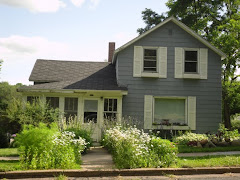
As to your questions about our house, it was actually, once upon a time, a farm house. The story goes that about a century ago, it was built by a man from a Sears & Roebuck kit as a wedding gift for his bride on a triple town lot, and that she spent her life turning the whole place into a garden and safe haven for chickens, rabbits and the like. The neighbor's house that we are praying/striving to add to our community sits on the other two lots, now. Slowly but surely, we keep tearing out bits of grass and replacing it with garden plots once again.
Shortly, there will be four who live permanently in our house. We have a couple of sofa-sleepers in the living room, the narrower of which can be dragged into the dining room if we have a family come to stay with us for short periods. What had been just "the library" is now Amanda and another girl's room, as it is the largest in the house. We are working hard to pay off the house so that we can make a contract with our neighbor, because we quite regularly have someone sacked out on at least one sofa. And, we've recently been asked by a couple who travel with the carnivals if they and some of their friends can pitch tents in our backyard and have access to our kitchen and bath this summer for the weeks before, during and after the Wisconsin Renaissance Faire--it won't be the first time we've had tents back there, and it definitely won't be the last, I'm sure.
We also have friends of the house in a couple of neighboring towns--mostly academics--who let us use their guest rooms in a pinch when we need them to make up for the space and resources that we lack. That's actually been helpful when we've had kids and young adults in violent situations (here's a clue to why this is such a deep-seated problem here: we live in a town of 1,200 people and we have *nine* bars within a five-mile area--alcoholism and multi-generational violence are no strangers here) who need to find some safe distance and quiet while we find other arrangements.
Our main charism at Gilbert House started out with just living and teaching sustainable community, but it has kind of shifted in a strange way to advocacy and shelter for young adults. We find ourselves putting alot of effort into shuttling abused or neglected teenagers to and from jobs to help them get their start, or to Red Cedar Medical Center's community behavioural health program so that they have a safe place to work through whatever might be causing their lives turmoil when it's more than can be dealt with here. We also try very hard to engage them with the local community; for instance we have quite a few elderly in our neighborhood and, as much as possible, we take a couple of kids with us here and there, go clean, weed, and tend those neighbor's yards and gardens if they cannot (and shovel and clear snow in the winter), use the refuse in our compost, and try to identify any needs that they might have that we can assist with--this has been a great tool for getting some of our kids interested in the lives and needs of others. When we identify those needs, we try to help meet them as best we can.
We are currently exploring a partnership with our local Newman Center and a couple of parishes in the neighboring diocese to help increase not only our local presence, but also to more strongly establish what we can do as a CW community to be proactive in healing and strengthening our local community. In the future, we hope to establish a sister house with a similar charism in nearby Menomonie. And we are always open to suggestions and new opportunities, just so long as they are in keeping with the Magisterial teachings of the Church (especially as they relate to social justice) and to the Aims and Means of the Catholic Worker Movement.
Thanks very much for your questions! If you'd like to know anything else, please don't hesitate to ask; we're happy to tell you!
Please pray for us.
Tuesday, October 20, 2009
On the Specialness of Mis-matched Spoons....
In 1999, at the old convent christened Star of the Sea, I sat with Ade and told her that two of her creations meant the most to me: the black crucifix that hung above the mismatched maple plank tables in the white house at Peter Maurin Farm and this simple paragraph about sharing hospitality in simple things. Should I have been surprised when she looked up from the page and asked, "Do you live it?"
This memory came again to me last night as I was getting ready for bed. I have a favourite chair that sits in my room; an old highback kitchen chair with a carved back and hollowed seat that has been painted at least a dozen different colours over the years. Its paint is chipped and worn, it's grimy black in places and its legs are battered. My mother is a master wood-craftsman; I know how to fix this, so why haven't I stripped and refinished this thing in the dozen-or-so years that I have had it in my stewardship? Because it is art, and it is too perfect on its own to touch. It goes with nothing, it stands alone, a pale blue eyesore with a checkered past of changing hands and changing hearts, discarded, passed on and neglected....until it passed to me. This chair is one of my finest treasures. It reminds me that beauty is found in the uncommonly commonplace if only you open your eyes to see it. It is, to me, at the deepest level a symbol of family. It is also a key to the mystery of my affections.
Few of the plates in our cupboard match, none of the bowls match the plates. Forks and knives and spoons in the drawers all come from different decades, different sets long ago lost, divided and forgotten. Blue, green and brown bottles from who-knows-where sit in window casings to catch and scatter the sunlight in the mornings. The dining room is littered to overflowing with plants that have been abandoned and adopted from just about everyone we know; the ivy is from a cutting my grandmother once snatched from the crannies a castle wall in Spain and snuck home in a book unnoticed. The living room and the library are stuffed with books once loved by others, then rescued from the dumpsteres of Thomas Loome, et al (I truly have no shame--my parents taught me well); I read them and share them as best as any truly gluttonous bibliophile is capable. You'd probably look at this place and be calling for a garbage truck, but for me? This is home, this is heart....this is a picture of real life.
I believe that family just happens to be whomever GOD chooses to set down in our path in any given moment. I believe that most of my family are as varied and as fragile and, yes, just as useful and as valuable as the books in our shelves, the chairs at our table, the spoons in our drawers. And I believe that heaven on earth is found in merging the whole lot together in the breaking of bread, the sharing of comforts, screaming and yelling at each other until the pain we each carry subsides, and those quiet moments resting with one another's company in the refracting blue-green light when nothing needs to be said at all.
Family isn't always pretty. Often they are old and needy and not terribly nice. Sometimes they have minds that are bent and souls that are chipped. All too often they smell like ashtrays or stale beer bottles or footlockers left far too long without a good scrub-down. Sometimes they act for all the world like a tenacious weed that you'd just love to strangle to death and be done with. Yet whilst their lives seem shallow, or sordid, or completely out-to-lunch, their souls' hearts are not. But if they weren't here? If they didn't fill my house with their cracked, broken, totally unorganised selves? This place would be empty and it would cease to be home.
Do I live the ideal of hospitality in mismatched chairs? I try. Often I fail...and then I remember that everything has some intrinsic value and beauty all its own...and I try again, saying to my own soul, "There is no such thing as a mismatched spoon, only a bit of art waiting to be cradled safely in the drawer with all the others." I need reminding and forgiveness if I somtimes forget.
Thursday, October 15, 2009
Gilbert House Annual Appeal
15 October 2009—Feast of St. Teresa of Avila
We now have only sixteen thousand dollars in principal left on our hundred-year-old farm house which we are working hard towards paying off over this next year. This news is great on the one hand because when we reconcile our home loan, we will save nearly sixty thousand dollars in interest and, subsequently, be able to address some much needed repairs on the house that the former owner was unwilling or unable to do. It will also provide us with the foundation we need to buy a second house next door for multiple long-term guests and additional community members--something we not only need in this area, but that we are anxious to see to fruition.
We are so grateful for the home that we share, thanks be to GOD, and look forward to the day when we will have more room and resources to share with others.
Our garden blew a gasket this past summer, and started bearing its young in the yard (which was really nice in some ways—it certainly cut down on our mowing chores). We grew so much surplus of such a wide variety of vegetables that we were actually turned away at the local food pantry (in all, we were able to give somewhere between five- and six-hundred pounds of produce to WestCap), and when they could take no more, we started calling friends, neighbors and family.
Our autumn harvest has been excellent. What wasn’t given away to those in need and to friends of the house has been eaten up or bottled and put away for the long winter, and we hope to share it still. We have two farmers and three neighbors who regularly give us too many apples for sanity—all of which have been made into pies, crisps, ciders, and jellies...or sauced, buttered and bottled. Mr. Erickson, from Rumar Farm over in Wilson, thinks it’s wonderful that he can split his rotting apples betwixt the chickens and us “girls” and that we’ll return next Spring with a “couple-or-three” bottles of wine for him.
We are currently working on another batch of the homemade "Petta" Merlot for the American Chesterton Society’s annual conference next summer, when Chestertonians from all over the world will be able to share in the age old tradition of hospitality of “beer and beef.” Every year Mary Alice claims that G.K. Chesterton, “that fat, long-winded dead man, took our heat away," because of the personal expense of making gallons and gallons of wine, but it always manages to work out anyway. Poor G.K. (for next year’s conference, I’m shooting for eighty gallons, just so that we have a store…just don’t tell Mary Alice.)
We have printed many of Mary Alice's card designs for sale and for gifting this year, hoping to show them at craft fairs and shops in the area; she will also be volunteering at John the Baptist parish’s annual Harvest Festival again (31 Oct.), where she hopes to share her artistry once again. Miki has been creating some very intricate scrapbook albums in addition to getting started on yet another huge new batch of altar linens and vestments for her “winter months” project; she will also be spending part of the winter putting together some "family history" scrapbooks for the American Chesterton Society that Ann Petta asked her to make. Friends of the house flit in and out with every imaginable project of their own, and it all keeps us busy and productive.
We have an eighteen-year-old girl who plans on living with us for the next year or more whilst she finishes high school and then enrolls in classes to become a licensed massage therapist; she plans on coming to stay in January and we are looking forward to having her here and getting the opportunity to support her desire to graduate and start her adult life.
Miki has taken on an outside job, part-time, with a temp agency to help bolster our income and our ability to aid the people who come to us looking for help. What cash we have brought into the house usually goes right back out the door, either on house necessities, or given freely to those who need it more than we do in any given moment--a thing that is becoming more and more common as the economy flounders and more of our neighbors lose their jobs.
And, now on to the really bad news: For the past three years we have been trying to get our roof fixed. The roofer we previously had made a bad situation worse, and we now have a ruined ceiling in the dining room that has grown a lovely community of mold. It’s going to cost $20,000.00 to fix, and we are looking forward to paying off the house so that we can do this without incurring a huge debt. We would much rather invest such a large amount of currency on "promiscuous philanthropy," but if the house is to remain standing, we have no choice.
For all of those who have been to the house to help with our many projects this past year, we offer you our heartfelt thanks because without you nothing would be as rewarding. For those people who have donated to the house and helped us to provide assistance to others in our community, there are no words to express our appreciation for you and the blessing that you are! For those of you who pray for us, we offer our own prayers for you and yours in return.
If you can help us with any of our current financial needs, we are humbled and grateful for your support, and we thank you now. If you’d like to take a look at our other house needs, photos of this year’s garden, or would just like more information on what we do and why, please take a look at our house blog at: http://gilberthouse.blogsp
Please remember that in keeping with Catholic Worker tradition we are not tax exempt and that we are decidedly so, as our co-founders have asked us to be. In that spirit, we ask our friends to give generously out of their abundance at a personal sacrifice, never asking for Caesar to acknowledge us with a tax credit for our gifts, but only that the GOD who knows their hearts acknowledge them as He will. So long as the poor are taxed, so will we be with them.
Friday, July 17, 2009
Wonders Truly Never Cease....
This is wonderful for us, and we look forward to writing again, sharing Mary Alice's art with you, as well as sharing our life here at Gilbert House and our local community.
We are so grateful to Dr. and Mrs. Uhlir and want them both to know how appreciative we are for their kindness.
Pax!
Miki, Mary Alice and Friends
Thursday, August 14, 2008
Los Alamos "Trespassers" Taken to Court For Praying....
14 August 2008
TAX-DAY ACTIVISTS GO TO COURT FOR PRAYING AT NUCLEAR SITE
As part of the April 15th vigil for peace, two members of Trinity Nuclear Abolitionists (TNA) were arrested across the street from Los Alamos National Laboratory. Mike Butler is awaiting a court hearing on his plea bargain, but Marcus Page goes to his jury trial on Monday the 18th of August. The two men were part of a group of six who held vigil during daylight hours on April 14th & 15th, praying in opposition to war taxes and international crimes committed there by the Lab. Charged with trespassing on Department of Energy land, both men believe they were praying openly along the public road in county territory, and they believe the Laboratory has no rights to conduct nuclear weapons work anywhere. TNA continues to conduct monthly vigils on Department of Energy land at Los Alamos National Laboratory.
Los Alamos National Laboratory (LANL) is a facility of the Department of Energy (DoE). Marcus Page received word last week that the Honorable Magistrate Pat Casados would not recuse herself. Page believes the judge is in a partnership with an employee of LANL, and was surprised by the refusal to recuse. Page says, "The DoE has set itself up in opposition to free speech in this case. The DoE's interests are at stake here. That means the people of the DoE will benefit from a verdict of 'guilty'. Shouldn't the employees of the DoE and LANL, and their spouses be excused from trying to judge who wins this case? Will nuclear abolitionists get a fair trial in a court staffed by nuclear profiteers?"
More info can be seen at http://Lovarchy.org/LANS
Contact
Chelsea @ Trinity Nuclear Abolitionists: 505 242 0497